Battery storage with a solar power system: when does it make sense?
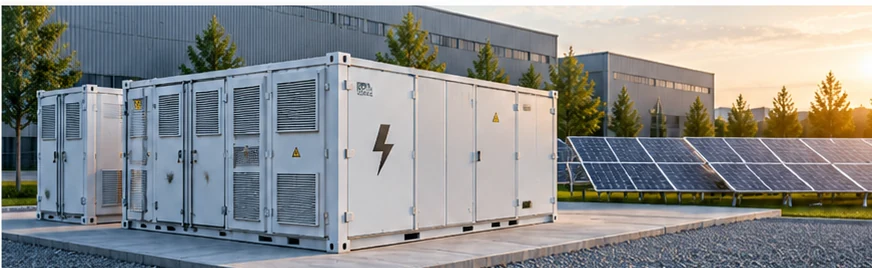
A solar power system does not always generate electricity when a business needs it most. Battery storage can save some surplus energy for later, but that does not mean a battery is cost-effective for every facility. We explain when it is worth considering a battery and which data to analyse before making a decision.
What does a battery do alongside a solar power system?
Put simply, a battery allows electricity generated at one time to be used later. If a solar power system generates more electricity between 11 am and 3 pm than the facility can use, some of that surplus can be stored in a battery. When generation falls later, the stored energy can be used to supply the facility.
How does it increase solar self-consumption?
Consider a business whose solar power system generates 500 kWh in one day. During the generation period, the facility can use 350 kWh directly, while the remaining 150 kWh cannot be consumed immediately. Without a battery, this surplus may be exported to the grid, depending on the technical arrangements and contract. With a battery, some of the energy can be stored and used later.
Illustrative example
- 500 kWh of daily solar generation
- 350 kWh consumed immediately at the facility
- 150 kWh of surplus before storage or export to the grid
When assessing a battery, it is therefore not enough to know the system's annual generation. It is important to know when it generates electricity and when the business uses it.
Can a battery help with peak loads?
Yes. Battery storage can be used to reduce short periods of high demand, a practice known as peak shaving. If a facility usually operates at a load of around 150 kW but briefly approaches 200 kW when machines start up or several loads operate simultaneously, a battery can supply part of the power needed at that moment.
A battery cannot replace grid connection capacity in every situation
It is important to distinguish a short peak from a sustained increase in power demand. If a facility occasionally needs an additional 30 or 50 kW for a relatively short period, a battery may be one option worth analysing. If a new production process requires an extra 100 kW for eight hours a day, the situation is very different.
kW and kWh: what is the difference?
With batteries, it is particularly important to distinguish power from energy capacity. The power rating of a battery system, expressed in kW, indicates how much power it can deliver at a given moment. Its energy capacity, expressed in kWh, indicates how much energy it can store.
Power · kW
How quickly the battery can deliver or receive energy.
Energy capacity · kWh
How much energy the battery can store.
For example, a battery rated at 100 kW with a capacity of 200 kWh is different from one rated at 200 kW with a capacity of 200 kWh. Both can store the same amount of energy, but they can deliver it at different power levels.
When does battery storage make sense?
- Surplus solar generation. Some energy is generated when the facility cannot use it immediately.
- Consumption after solar generation falls. The facility continues operating later in the day.
- Short periods of peak demand. More power is occasionally needed than during normal operation.
- Limited grid connection capacity. New loads bring the site close to its existing limit.
- Planned growth in electricity consumption. New machines, processes or charging stations are being introduced.
When might a battery make less sense?
If a facility already uses most of its solar electricity directly while it is being generated, there may be relatively little scope to increase self-consumption. The same applies if demand is very stable, there are no pronounced load peaks and sufficient grid connection capacity is available.
What should be analysed before making a decision?
A sound analysis starts with facility data, rather than a battery catalogue. It should examine the electricity consumption profile, the solar generation profile, the amount and timing of surplus energy, peak loads and expected future consumption.
Scenarios worth comparing
Solar without a battery → solar with a battery → demand management → increased grid connection capacity → a combination of solutions
The largest battery is not necessarily the best battery
Greater capacity means a larger investment. If that capacity is rarely used during the year, the extra cost may not deliver corresponding additional value. The right question is therefore not “How large a battery can we install?” but “How much battery capacity do we actually need, and what will it achieve?”
Solar, battery storage and consumption should be designed together
The solar power system determines how much electricity you can generate. The consumption profile determines how much of that electricity you can use immediately. A battery can change when you use some of that energy, while grid connection capacity sets the limits within which the whole system must operate.