Can Your Company Earn Revenue from Electricity Demand Flexibility?
From existing production breaks to balancing markets: where value comes from and what businesses need to verify before forecasting revenue.
Energy in Practice
Value can lie in the operating schedule
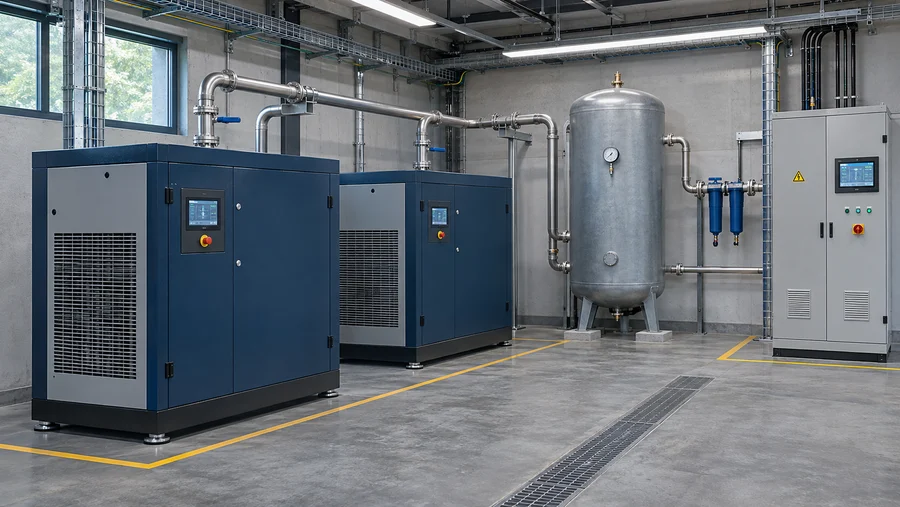
A compressor need not run at full output at every moment to keep production supplied with compressed air. Refrigeration equipment can bring some operation forward within safe temperature limits. Some manufacturing processes already include breaks between stages. These assets may give a business something that is easy to overlook on its electricity bill: a choice about when to draw power.
That choice can reduce costs or support a market service. A controllable load, however, becomes a commercial resource only when its response can be measured reliably, delivered on time and contracted on terms that justify the costs and operational risks.
A Polish foundry put an existing break to work
Polish industrial company Metalodlew enrolled three furnaces in a demand response programme, with a total reported flexible capacity of 12 MW. One induction furnace has a capacity of 6 MW, while two electric arc furnaces each have a capacity of 3 MW. The process of melting metal and cast iron includes technological breaks of approximately 2.5 to 4 hours, allowing electricity demand to be adjusted.
The commercial logic is to match programme requirements with an existing production cycle. Croatian industrial businesses can start with the same practical question: where does the process already allow a change? Market participation can then be assessed against those limits. The Polish example does not establish an equivalent outcome elsewhere. The public account gives no earnings figure from which to forecast another facility's revenue.
Metalodlew · documented capacity
Induction furnace
Arc furnace
Arc furnace
12 MW · technological breaks of 2.5 to 4 hours
Why does Europe need more flexibility?
Solar and wind output changes through the day. The electricity system therefore needs resources that can adjust generation, storage or demand. The 2025 ACER / CEER report, drawing on ENTSO-E's 2024 study, shows annual daily flexibility needs rising from a modelled 222 TWh for 2025 to 328 TWh for 2028 and 426 TWh for 2030.
“Daily” describes the timescale of flexibility; the energy volume is expressed per year. It does not mean that many TWh every day. These figures are neither achieved market turnover nor business revenue. Nor are they an allocation exclusively for demand response. They indicate system needs that different technologies may help meet.
Modelled annual requirements for daily flexibility
TWh/year
Croatia: new processes, specific entry requirements
HOPS launched its new Balancing Platform on 15 September 2026. Balancing capacity is offered in six four-hour blocks through day-ahead procurement. Participants can use a web interface or M2M communication for automated data exchange. In its 18 September announcement, HOPS expected connection to PICASSO for aFRR and MARI for mFRR during 2027. That announcement should not be presented as completed integration.
Amendments to Croatia's Electricity Market Act were published on 7 October 2026 in Official Gazette 114/2026 and entered into force on 15 October. Article 23 of the amendments introduces Article 91a: HOPS is to adopt a flexibility needs report every two years, subject to prior HERA approval. This does not qualify an individual facility. The amendments must be read alongside the pre-existing legal framework for aggregation. Aggregation did not first become possible in October 2026.
The October amendments expressly add an aggregator's right to participate in all electricity markets without the consent of other system participants. New Article 23(9) names balancing, ancillary services and wholesale markets. Paragraphs 12 and 13 also provide for technical requirements reflecting market characteristics and participation by aggregated loads. Market access rights and demonstrated capability to deliver a particular service remain distinct.
A legal right to participate does not replace technical qualification. Each facility needs an assessment of the relevant product, metering, communications, response testing and contractual obligations. A business may participate within an aggregated group, but responsibility for delivery of the contracted service still has to be assigned.
Three benefits that require separate calculations
Load shifting reduces costs when operation moves to a period with a lower price actually paid under the supply contract. A lower wholesale price does not automatically change every customer's bill. Shift changes, equipment losses, extra operating effort and subsequent rebound consumption must enter the calculation.
Peak demand management can reduce demand charges where the tariff links them to measured maximum demand. A brief reduction provides no benefit if the billing peak occurs in another interval. The analysis must cover the full billing period and the applicable tariff calculation.
Market flexibility services can earn revenue for contracted capacity availability and/or activated balancing energy, depending on the product and agreement. Balancing capacity is measured in MW and balancing energy in MWh. Payment for availability does not imply continuous full activation. Enrolment alone does not guarantee activation revenue.
Three different economic mechanisms
Load shifting
Energy cost savingsDepends on contracted prices and the cost of rescheduling.
Peak management
Demand charge savingsDepends on tariffs and the billing maximum.
Balancing
Market revenueCapacity and activated energy are settled differently.
These benefits cannot simply be added together. The same capacity may be needed for production, peak management and a market commitment. Compare compatible operating scenarios and deduct automation, metering, maintenance, aggregator fees and potential non-delivery costs from the gross effect.
aFRR and mFRR: capacity is only the starting point
aFRR is frequency restoration reserve with automatic activation; mFRR uses manual activation. HOPS specifies a minimum balancing capacity bid of 1 MW for the products shown here. Full activation must be achieved within five minutes for aFRR and fifteen minutes for mFRR.
Basic HOPS product parameters
aFRR
1 MWMinimum bid
≤ 5 minFull activation; automatic response
mFRR
1 MWMinimum bid
≤ 15 minFull activation; manual activation
A facility must sustain the adjustment, rather than briefly touch the required power level. Activation duration, repeat calls, process recovery and availability throughout the offered period all matter. A cold store's thermal margin or a compressed-air buffer is finite. Faster control without an understanding of the process can create costs that outweigh the benefit.
What does a 200 kW reduction mean?
Consider a system with a reference load of 600 kW. It reduces its draw to 400 kW for 30 minutes, then operates at 700 kW for 30 minutes before returning to 600 kW. This is a numerical illustration, not a measured facility profile or evidence of a qualified balancing service.
Illustrative load profile
Solid green: adjusted load. Dashed: 600 kW reference.
Reduction: 200 kW × 0.5 h = 100 kWh less electricity drawn.
Rebound: 100 kW × 0.5 h = 50 kWh additional electricity drawn.
Difference over the illustrated hour: 50 kWh less than the reference profile.
The example does not assume full recovery of deferred energy. Any later consumption needs to be recorded separately. The net difference is not automatically recognised as balancing energy: settlement depends on the accepted baseline methodology, metering, instructions and product rules. Electricity bill savings cannot be calculated without the relevant price for each interval.
Where should a business look for potential?
Cold stores and food businesses can investigate thermal inertia while preserving temperature limits, hygiene and product quality. Manufacturing plants can assess compressors, pumps, furnaces and pauses between batches, accounting for quality, wear and safe restarting.
Hotels and large commercial buildings can adjust heating, cooling and hot-water production where comfort and health requirements allow. Logistics facilities must protect dispatch schedules and the cold chain. Electric vehicle fleets can schedule charging while vehicles are connected, with departure energy guaranteed. Installed charger capacity is not the same as available flexibility.
How can an aggregator combine smaller resources?
Five facilities with 200 kW of potential flexibility each have an arithmetic total of 1 MW. That is not yet a confirmed 1 MW bid: the resources must be qualified and available at the required time. One unavailable facility can reduce deliverable capacity. Equipment nameplate ratings, qualified capacity and current availability are three different measures.
From facility to market
Data: business → provider → HOPS.
Instructions: HOPS → provider → business.
Settlement: HOPS ↔ provider ↔ business.
The definition in Article 3(1)(4) covers combining power and energy from multiple users for participation in any electricity market. An aggregator combines resources and organises their market participation. The agreement should identify who handles qualification, funds equipment, sends instructions, verifies delivery and produces settlement statements. It should also identify the balancing service provider facing HOPS, assign imbalance responsibility and define revenue sharing, fees and non-delivery risk. Aggregation arrangements must be assessed against the complete applicable legal and contractual framework.
Imbalance responsibility must be explicitly allocated: Article 28(4) provides that the aggregator is a balance responsible party or contractually delegates that responsibility under the applicable rules. A business should be able to identify the party assuming that obligation in its agreement.
Five questions before a detailed assessment
- Which assets draw the most power, and what are their actual time profiles?
- How much consumption can be deferred, reduced or increased without compromising output and quality?
- How quickly can the system respond, and how long can it sustain the adjustment?
- What process limits, recovery times and intervention frequencies apply?
- Are interval metering, data and automation available to demonstrate delivery?
Where the answers are unknown, start with measurement. Identify repeatable opportunities in the load profile and calculate net benefits after all additional costs. Contract offers can then be compared on a meaningful basis.
Flexibility is worth what can reliably be delivered
For some businesses, the main benefit will be a better operating schedule. For others it may be a lower billing peak or a contracted market service. Electricity demand flexibility can have economic value when it is technically feasible, accepted by the relevant market and financially justified. A sound project starts with understanding the facility and leads to an agreement that clearly allocates obligations and benefits.
Could your business benefit from electricity demand flexibility?
Discover whether your facility has the potential to reduce electricity costs or generate additional revenue by adjusting its electricity demand.
Share a few details about your electricity consumption and operations. We will assess whether a more detailed technical and financial evaluation could be worthwhile.
Request a Free Preliminary AssessmentNo obligation to proceed with a project.