Surplus solar energy: what is it worth to your business?
A solar installation can generate more electricity than your site needs at that moment. That surplus can create business value, but its value depends on when it is generated, the terms for exporting it and the opportunities to use it later. How do you choose an approach that fits the way your business actually operates?
At sunny midday, a manufacturing site may be running at full load. The same rooftop may produce more electricity than the site consumes on weekends, during shutdowns or at a business operating mainly at night. A single annual total does not reveal these differences.
Surplus energy is neither automatically wasted nor guaranteed revenue. It can be exported, used by shifting suitable demand or stored for later. If the site cannot use or export it, generation must be limited to meet the system's technical requirements.
Annual totals do not show the timing match
Two businesses can have the same annual electricity consumption and solar installations of the same capacity, yet use different shares of solar generation directly. A daytime operation may use more as it is generated; a site with substantial night-time demand may have larger daytime surpluses. Compare time profiles, rather than annual bills alone.
Power and energy are different quantities
kW measures power at a particular moment; kWh measures energy over time. The simplified example below refers to the AC side of one site, without a battery or other generation, and assumes constant power throughout the interval.
| Solar output | Site demand | Result |
|---|---|---|
| 250 kW | 300 kW | 250 kW supplied by solar; 50 kW imported |
| 250 kW | 100 kW | 100 kW used directly; 150 kW potential surplus |
If the second scenario lasts 15 minutes, the potential surplus is 150 kW × 0.25 h = 37.5 kWh. This is not necessarily the actual export: a battery or flexible loads may absorb some of it, or generation may be curtailed.
Four ways to manage surplus
The best approach may combine several options. Assess each against the site's conditions, operating requirements and implementation costs.
1. Grid export: check the terms and value
In Croatia, exports by a customer with its own generation depend on approved connection conditions and the relevant contractual arrangements. HEP ODS distinguishes approved capacity for electricity imports from approved capacity for generation; the purchase of exported energy is governed by the applicable agreement. Installed solar capacity alone does not establish that all output may be exported. [1, 2]
Check the permitted export power, settlement method, purchase price or pricing formula, contract duration and any charges. Do not assume an exported kWh has the same value as a purchased kWh. Establish the terms for the specific project. [1]
2. Demand shifting: start with the process
Where operations allow flexibility, some demand can move into sunny hours: vehicle charging, hot-water preparation or certain auxiliary systems, for example. This only makes sense if product quality, delivery deadlines, safety and overall operating costs are protected.
The aim is to reschedule necessary demand, rather than create unnecessary consumption. Assess automation and the energy management system (EMS) against equipment compatibility, data availability and the actual scope of control.
3. A battery: move energy to a more useful time
A battery can store some daytime surplus and supply it when the site needs electricity. Storage incurs losses, and energy capacity in kWh is distinct from charging and discharging power in kW. Rated capacity alone therefore cannot show how much surplus can be absorbed within a given period. [5]
The business case must account for useful delivered energy, differences in energy value, investment and maintenance costs, degradation and warranty conditions. Several days of surplus do not automatically justify a battery sized to store all of it. A higher self-consumption share alone does not prove a better financial result.
4. Curtailment: include it in the model
If export is prohibited or limited and demand and storage cannot absorb generation, solar output must be limited in accordance with the project's requirements. Inverter documentation provides a technical example of this control. [6] Include the resulting unutilised generation potential in the assessment. Accepting some curtailment can be more economical than investing in additional equipment solely to avoid every surplus kWh.
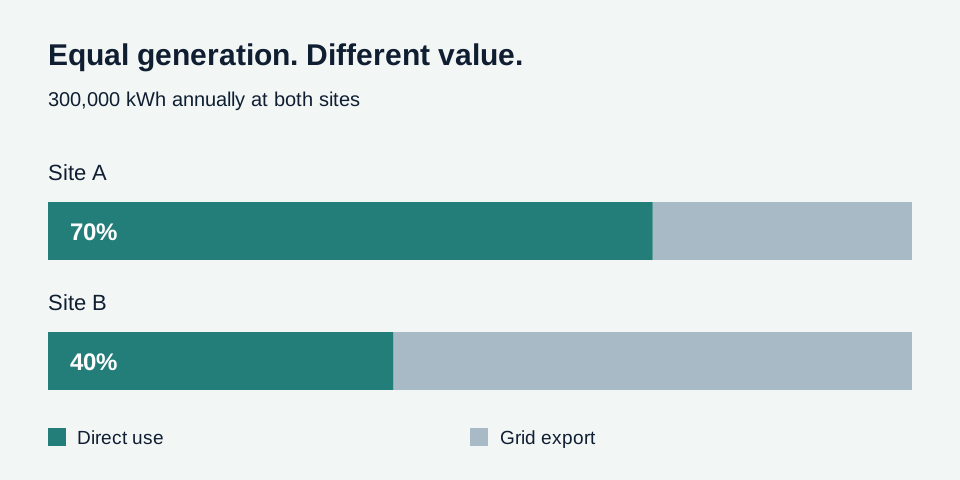
Equal generation, different business value
300,000 kWh annually at both sites
Site A
Site B
Direct use
Grey: grid export
For a simplified assessment, separate solar energy used directly from energy exported. Value the first at the purchasing cost actually avoided and the second at achievable export terms. Fixed bill costs do not disappear simply because fewer kWh are imported.
Illustrative scenario, not an offer or market forecast. Both installations deliver 300,000 kWh annually. Assume an avoided variable purchasing cost of EUR 0.14/kWh and an export value of EUR 0.06/kWh. For simplicity, both values remain constant throughout the year, with no battery or curtailment.
| Annual measure | Site A | Site B |
|---|---|---|
| Solar energy used directly | 210,000 kWh (70%) | 120,000 kWh (40%) |
| Grid exports | 90,000 kWh | 180,000 kWh |
| Value of direct use | EUR 29,400 | EUR 16,800 |
| Export value | EUR 5,400 | EUR 10,800 |
| Total illustrative gross value | EUR 34,800 | EUR 27,600 |
The difference is EUR 7,200 annually, despite equal generation. Site A uses an additional 90,000 kWh directly, at an assumed value difference of EUR 0.08/kWh. The example isolates the effect of timing; it does not describe a real company or guarantee savings.
These amounts are not profit, net cash flow or a payback calculation. Investment, financing, maintenance, degradation, tax treatment and price changes are excluded. An actual assessment uses the business's tariff and contractual terms and time profiles.
Assessing the additional value of a battery
If energy could be sold without a battery, the forgone sale is an opportunity cost of storage. For each cycle, compare the value of later avoided purchases, after losses, with the value of energy that would otherwise be exported. Allow for cycling costs, auxiliary consumption and maintenance. Do not count benefits twice for the same kWh.
The largest solar installation is not necessarily the best investment. Compare several installation sizes, with and without demand management and storage. Base the decision on total project value over its lifetime, rather than the maximum number of panels.
Data to prepare before deciding
Start with at least one representative year of operation. Where available, use 15-minute or other interval data, with an explanation of shifts, weekends and shutdowns. HEP ODS provides metering-data access to authorised users; check availability and resolution for the specific metering point. [3]
If solar is already installed, grid imports alone do not represent the site's total consumption. Generation and export data are also needed; with a battery, its energy flows are required too, to avoid misestimating demand.
Demand profile. Interval readings, operating hours, weekends, holidays and seasonal shutdowns.
Generation profile. Location, orientation, tilt, shading, technical losses and expected generation over time.
Connection and contracts. Approved capacities, export limits, tariff components and surplus-purchase terms.
Business plans. New shifts and machinery, process electrification, vehicle charging and expected growth.
Investment scenarios. Several solar sizes, realistic storage and control costs, and sensitivity to prices and demand.
The European Commission's PVGIS can estimate an hourly PV generation profile for a location. Modelled data are not a yield guarantee. When comparing with 15-minute readings, align time resolution, time zone and daylight saving time; an hourly model does not capture every short-term fluctuation. [4]
Let's discuss your project
The first step is to understand the site before choosing a panel count or battery size. EMISSIO TRADE can help develop a project concept and connect technical and commercial options, within a scope agreed for the specific project.
Tell us about your site, demand profile and investment objective.
Sources and verification
[1] HEP Opskrba: customers with own generation, purchase and contracts
[2] HEP ODS: customers with own generation, approved capacities
[3] HEP ODS: metering-data portal
[4] European Commission, JRC: PVGIS hourly data and PV output
[5] U.S. Department of Energy: solar energy and storage
[6] Fronius: technical example of dynamic export limiting
Sources checked on 11 October 2026. Examples are original, simplified and arithmetically verified. Connection and settlement terms must be checked against the applicable documents for the specific project. The Croatian connection and contracting discussion refers to Croatia; it is not a statement of rules in other markets.